

Subjects
 Political Science
 download catalogue
Representations



Recent View(s)
- Cyber Warfare: The Power of the Unseen
- Understanding Anand Sahib: The Song of Bliss
- Contemporary Chinese Political Thought Debates and Perspectives
- Eurasian States: Socio-Economic and Political Processes
- Indian Aircraft Industry: Possible Innovations for Success in the Twenty-First Century
- INDIA IN SOUTH ASIA: Changing Perspectives in the 21st Century
- Unmanned Aerial Systems: Transforming Contemporary Air Warfare
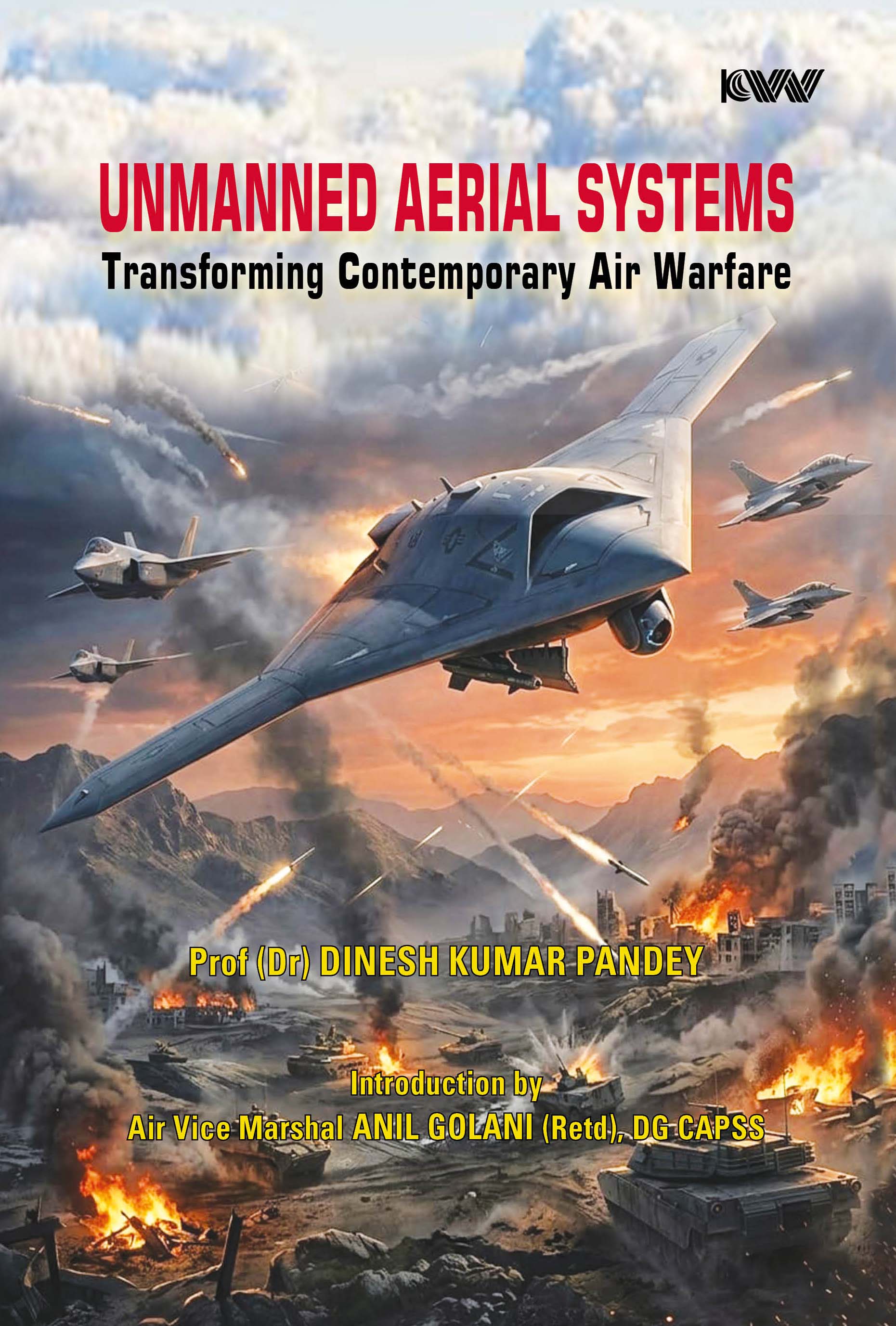
Unmanned Aerial Systems: Transforming Contemporary Air Warfare
Prof (Dr) Dinesh Kumar Pandey Introduction by: Air Vice Marshal Anil Golani (Retd), DG CAPSS
The development of air power has been characterised by technological advancements such as the jet engine and precision munitions. The emergence of Unmanned Aerial Systems (UAS) signifies a comparable turning point, transforming from basic reconnaissance instruments into a sophisticated network of autonomous platforms proficient in strike operations, electronic warfare, and strategic deterrence.
The genuine influence of UAS resides in the alteration of the “kill chain” and the clarity of the battlespace. Through sustained ISR and algorithmic targeting, these tools have transformed operational art, imposing disproportionate costs in both counter-insurgency and high-intensity conventional warfare.
‘Unmanned Aerial Systems: Transforming Contemporary Air Warfare ’ examines this transition through three perspectives:
Foundations: The technological advancement and the discourse on manned vs unmanned superiority.
Regional Context: The spread of UAS inside India’s strategic vicinity, emphasising contested borders and grey-zone warfare.
Future Frontiers: Advanced concepts such as Manned-Unmanned Teaming (MUM-T), swarm warfare, and counter-UAS frameworks.
This book critically examines UAS, highlighting their vulnerabilities in cyber domains and reliance on spectrum, rather than perceiving them as a solution to all problems. Designed for practitioners and policymakers, it amalgamates operational case studies and doctrinal transformations into a cohesive narrative regarding the future of aerospace and information warfare.