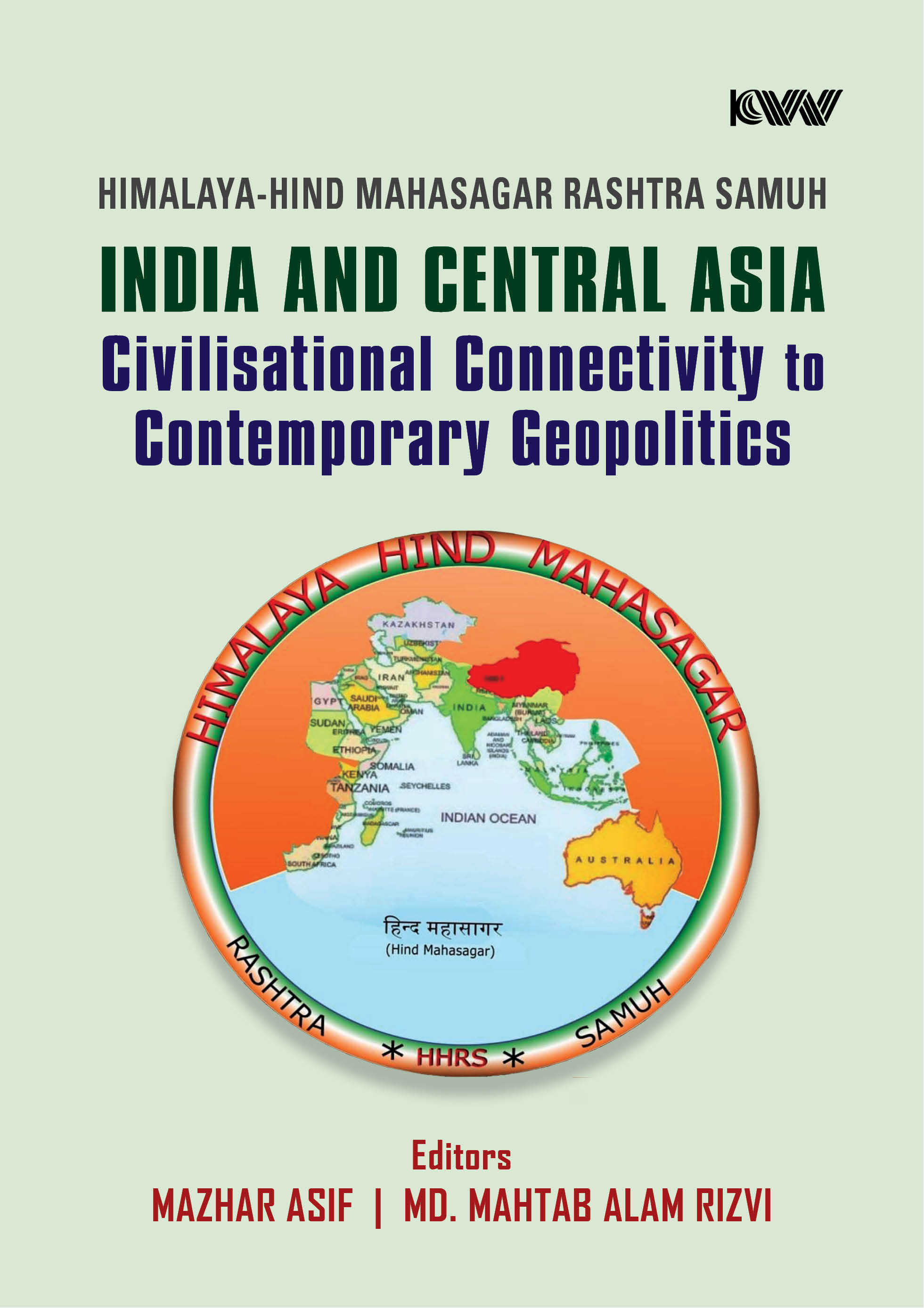
India and Central Asia: Civilisational Connectivity to Contemporary Geopolitics is a forward-looking volume that re-examines centuries old connections between India and the Central Asian Republics Kazakhstan, Kyrgyzstan, Tajikistan, Turkmenistan, and Uzbekistan within today’s shifting geopolitical landscape. Since the collapse of the Soviet Union, these states have consolidated sovereignty, managed regional security concerns, and pursued balanced, multi-vector foreign policies with resilience and strategic maturity. Conceptualized under the Forum for Awareness of National Security (FANS), the book views national security not only through military strength, but also through culture, connectivity, and enduring partnerships. It highlights Central Asia’s agency while exploring how shared history rooted in trade, scholarship, and spiritual exchange can inform cooperation in energy, counter terrorism, digital connectivity, education, and diplomacy. Blending historical insight with policy relevance, the volume presents India’s renewed engagement as a reconnection of historically linked societies shaping a stable and collaborative future in an increasingly multipolar world.
Editors : MAZHAR ASIF | MD. MAHTAB ALAM RIZVI
Prof. Mazhar Asif currently serves as the Vice-Chancellor of Jamia Millia Islamia. A distinguished scholar of Persian studies, Indian knowledge systems, Sufism, and mysticism, with over two decades of academic experience, he has served as Professor and Chairperson at Jawaharlal Nehru University and as Professor at Gauhati University, in addition to holding key administrative positions including Dean and Chief Vigilance Officer at JNU, New Delhi. He is also a founding member associated with the formulation of India’s National Education Policy (NEP) and has contributed to national academic bodies connected with the policy. An accomplished author and editor, Prof. Asif has written and edited several significant works, including Tarikh-e-Aasham and Aitihasic Patabhumit Asomor Aitijyamandita Islamdharmi Sakal, and has compiled a comprehensive Persian–Assamese–English dictionary. He has received several honors such as the Mithila Ratna Samman and the President’s Medal from Afghanistan. He is widely recognized for his academic leadership and his commitment to strengthening India’s Persian and cultural heritage.
Prof. Md. Mahtab Alam Rizvi is a distinguished scholar of International Relations and West Asian Studies and currently serves as Registrar of Jamia Millia Islamia. A professor and former Director at the Nelson Mandela Centre for Peace and Conflict Resolution, he is widely recognized for his work on India–Iran relations, regional security, maritime strategy, and India’s foreign policy. His research explores West Asian geopolitics, energy security, nuclear doctrine, and strategic affairs. He is also the Editor of ‘Himalaya-Hind Mahasagar Rashtra Samuh: Revitalizing the Culture and Maritime Trade Relations’ and contributed significant chapters to leading scholarly works, including “India and Iran: Progress and Prospects of an Evolving Security Relationship” in Asian Strategic Review 2015. He has also published extensively in Strategic Analysis, shaping strategic studies and policy discourse in India.
Contents
Foreword
Contributors
Tables, Figures, Maps and Picture
Concept of the Himalaya-Hind Mahasagar Rashtra Samuh (HHRS)
Hon’ble Dr Indresh Kumar
1. Introduction
Mazhar Asif , Md. Mahtab Alam Rizvi & Golok Bihari Rai
2. Bharat’s Constructive Rise and China’s Expanding Presence: Recasting the Great Game in Central Asia
Md. Mahtab Alam Rizvi & Sudhanshu Trivedi
3. Central Asia-India: Problems and Prospects for the Development of “Soft Power” and Creative Diplomacy
Nazgul Abalova & Aliya Abdykerimova
4. Central Asian Zoomorphic /Animal Style and Hinduism: A Synthesis of Cross-Cultural Links in Tillya-Tepe
Laura Yerekesheva
5. Integration Processes in Central Asia: Implications for India
Seyit Ali Avcu & Ehteshamul Haque
6. Rational Choice Model: Regional Connectivity Case
Mavluda Nurmetova MA & Ulugbek Khasanov
7. Iran-India Relations and its Implications for Central Asia
Yousof Qorashi
8. The Revival of the Past: Turkey’s Vision of Neo-Ottomanism and Its Influence on Central Asia
H.A. Nazmi
9. Historical, Cultural, and Economic Relations of Tajikistan and India
Ghafuri Zoir Sadullo
10. Indology in Tajikistan: Reflection of Relations between States
Muzaffar Olimov
11. Indo-Tajik Cultural Relations: Past, Present, and Future Prospects
Zulfikar Ali
12. The Strategies of Developing the International North-South Transport Corridor (INSTC) Regional Society
Mandana Tishehyar
13. India-Central Asia: A Tapestry of Historical, Cultural, and Economic Bonds
Ishrat Naaz
Conclusion
Mazhar Asif & Md. Mahtab Alam Rizvi
Index


 Political Science
 download catalogue