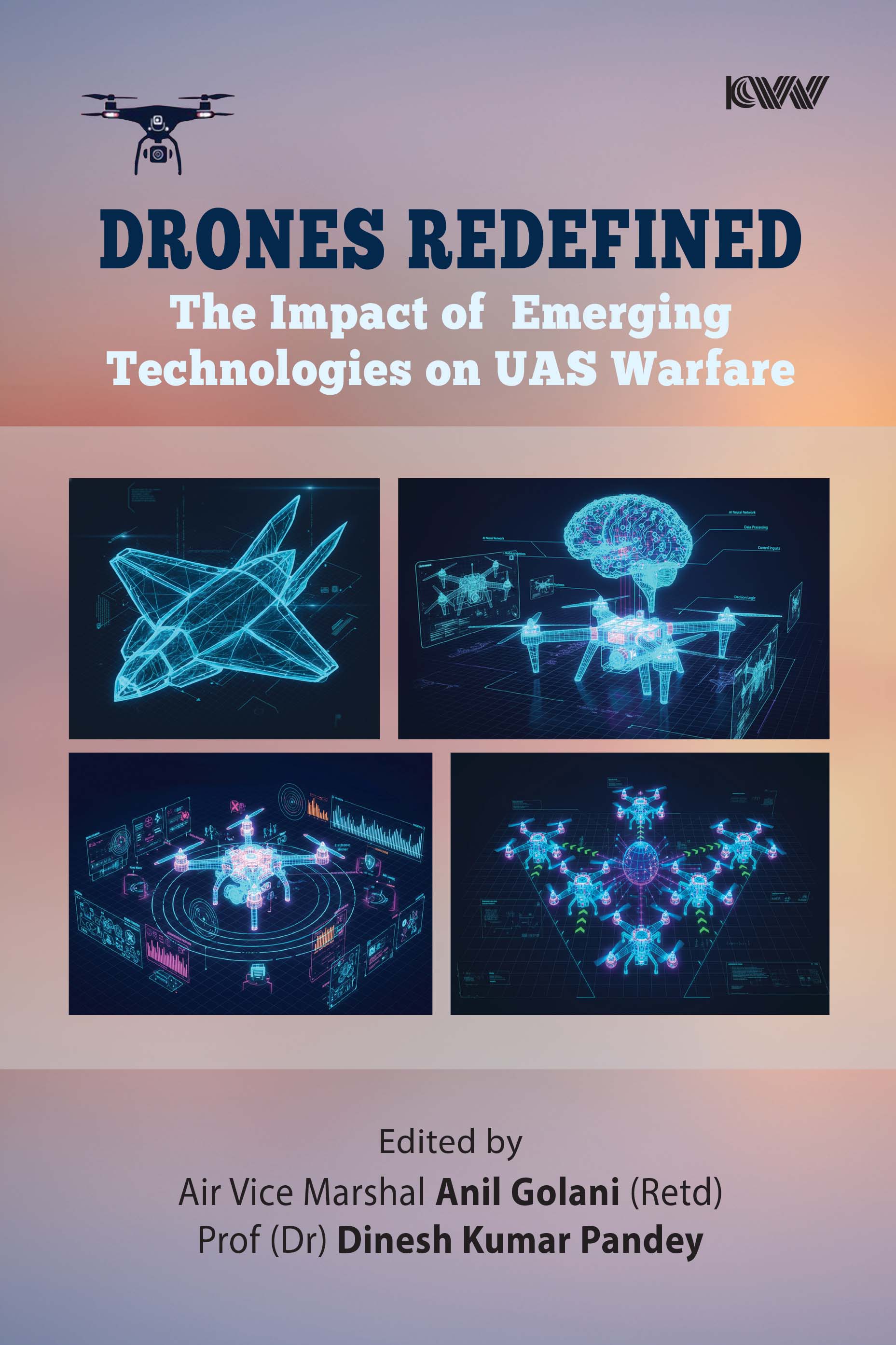
Drones Redefined: The Impact of Emerging Technologies on UAS Warfare is an attempt by the Centre for Aerospace Power and Strategic Studies (CAPSS) to provide a structured and forward-looking analysis of Unmanned Aerial Systems (UAS) warfare, progressing from foundational transformations to disruptive future trajectories. Section I, “Cruising High,” maps the evolution of UAS from remotely piloted platforms to increasingly autonomous combat systems. It analyses how stealth technologies, artificial intelligence, and electronic warfare are reshaping survivability, decision-making speed, and tactical flexibility. Dedicated chapters assess swarm intelligence, autonomous operations, hypersonic integration, and cyber warfare, highlighting how these domains compress the observe–orient–decide–act (OODA) loop while simultaneously introducing new vulnerabilities. The section concludes with an in-depth assessment of counter-UAS technologies, addressing detection, tracking, and neutralization challenges in contested airspaces. Section II, “Evolution to the Next Level,” focuses on capability enhancement and strategic escalation. It examines advanced materials, propulsion systems, and sensor fusion as force multipliers that expand endurance, payload, and situational awareness. This part also addresses the highly consequential issue of nuclear weaponization of UAS, evaluating its implications for deterrence stability, escalation dynamics, and contemporary warfare. Collectively, the book offers a comprehensive framework for understanding how emerging technologies are redefining UAS operations, doctrine, and strategic risk.
Edited by: Air Vice Marshal Anil Golani (Retd) and Prof (Dr) Dinesh Kumar Pandey
Air Vice Marshal Anil Golani, a QFI and an Instrument Rating Instructor and Examiner, had commanded an Air Defence Direction Centre, an operational base and served in senior ranks in both the Joint Services Commands of the country, the Andaman & Nicobar Command as the Air Force Component Commander and Strategic Forces Command as the Chief Staff Officer (Air Vector). He was Air Officer Commanding Maritime Air Operations and Chief Instructor, Air Force, at the DSSC. He is Director General of CAPSS since April 1, 2024.
Prof (Dr) Dinesh Kumar Pandey, a Master Fighter Controller (MFC), had commanded six Air Defence Units. He was Director of Air Staff Inspections and Director of the Joint Control and Analysis Centre. He has been a Professor in the School of Business (Aviation Management) at GU. As a defence and strategies analyst, he is panellist of various national TV channels. He is currently a Senior Fellow at CAPSS, Adjunct Professor, RRU; a member of the Advisory Council of GNOIT and Foreign Policy School.
Contents
Editor’s Note
Anil Golani
Tables and Figures
Abbreviations
Section I: Cruising High
1. UAS Warfare: Evolution and Future Trends
Ashish Vohra
2. Impact of Stealth Technology on UAS
Sukhchain Singh
3. Artificial Intelligence in Unmanned Aerial Vehicles: Enhancing Decision-Making and Developing Tactics
Khyati Singh
4. Emerging Technology and Operational Concepts for the Future of EW and UAS
Daljit Singh
5. Autonomous Systems: The Future of UAS Warfare
Siddharth Maurya
6. SWARM Intelligence and UAS: Tactical Implications and Potential Applications
DK Pandey
7. Impact of Hypersonic Technology on UAS
Javed Alam
8. Cyber Warfare and UAS: Vulnerabilities and Counter-Measures
Devesh Vatsa
9. Counter-UAS Technologies: Detecting and Neutralising Adversarial Drones
DK Pandey
Section II: Evolution to the Next Level
10. Advanced Materials and Propulsion Systems: Enhancing Unmanned Aerial System Performance
Shashiker Choudhary
11. Sensor Fusion and Multispectral Sensors: Enhancing UAS Surveillance Capabilities
Arvind Pandey
12. Unmanned Escalation: Examining the Viability of Nuclear Weaponisation of Unmanned Vehicles
Roshan Khanijo
Editors and Contributors
Index


 Political Science
 download catalogue