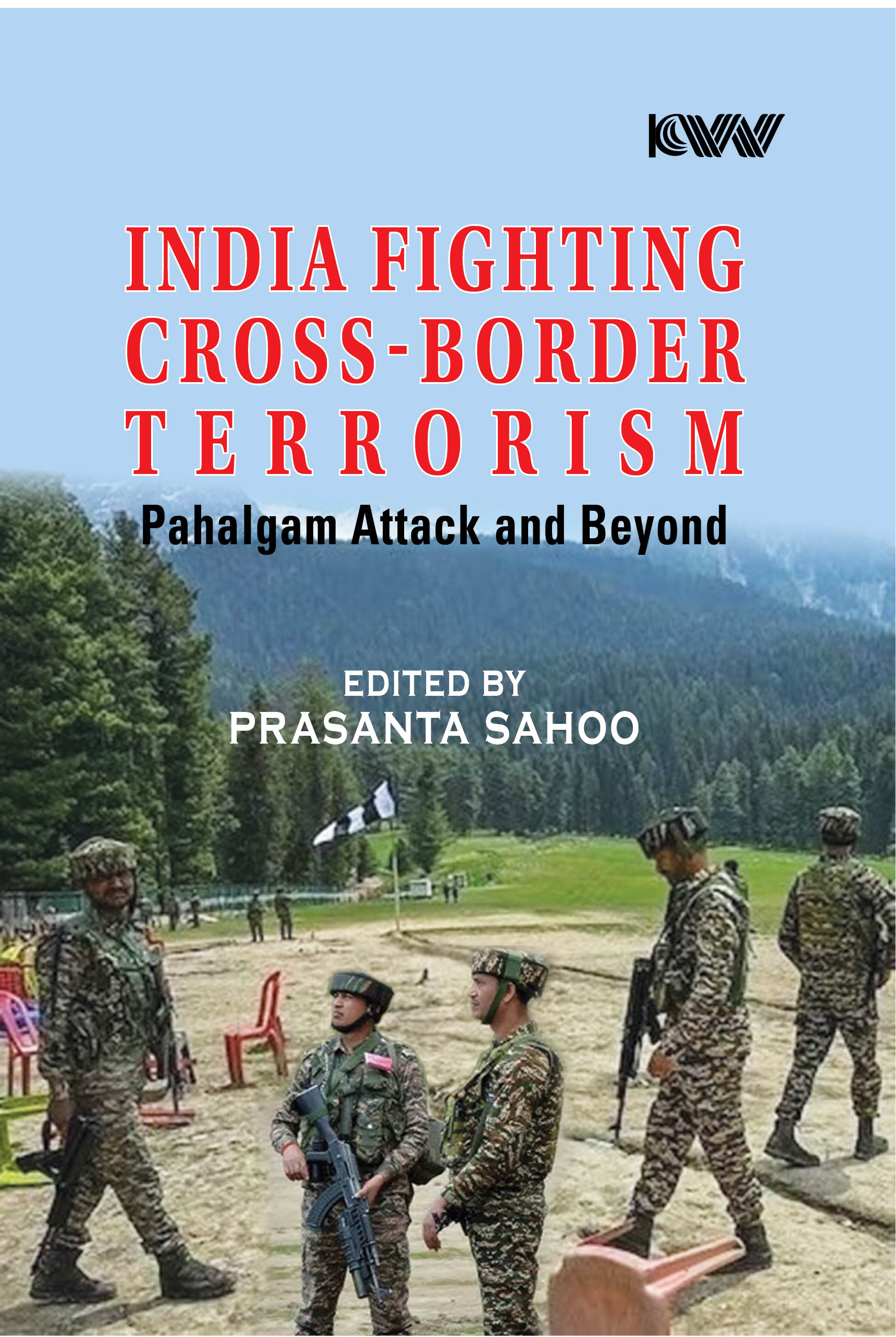
India Fighting Cross-Border Terrorism: Pahalgam Attack and Beyond is a timely edited volume that offers a comprehensive and multidisciplinary examination of one of the most pressing security challenges confronting India today. Set against the backdrop of the Pahalgam attack and its wider strategic implications, the book explores the evolving nature of cross-border terrorism, its impact on national security, and the policy options available to strengthen India’s counter-terrorism framework.
The volume brings together distinguished professors and scholars from leading universities and diverse academic disciplines, including International Relations, Political Science, Strategic Studies, Security Studies, Law, Public Policy, and Area Studies. Their collective expertise provides a nuanced understanding of terrorism by integrating strategic, political, legal, technological, and socio-economic perspectives.
The chapters examine critical issues such as cross-border infiltration, intelligence and security cooperation, border management, radicalisation, cyber-enabled terrorism, legal and institutional responses, regional geopolitics, and international collaboration in combating terrorism. Combining rigorous academic research with policy-oriented analysis, the volume contributes to contemporary debates on India’s national security and regional stability.
Designed for scholars, students, policymakers, security professionals, and informed readers, this book offers valuable insights into India’s evolving counter-terrorism strategy and highlights pathways for strengthening national resilience in an increasingly complex and dynamic security environment.
Edited by: Prasanta Sahoo
Dr. Prasanta Sahoo is an Associate Professor and a distinguished scholar of International Relations, specialising in India’s border management, national security, and strategic affairs. He is a faculty member in the Centre for International Politics, Organisation and Disarmament, School of International Studies, Jawaharlal Nehru University (JNU), New Delhi, India. He earned both his M.Phil. and PhD from SIS, JNU, New Delhi, where his research focused on Border Management and India’s National Security. His academic interests include border governance, terrorism and counter-terrorism, internal security, international migration, India’s neighbourhood policy, and regional security.
Over the course of his academic career, Dr. Sahoo has made significant contributions to the study of India’s security challenges through his teaching, research, publications, and participation in national and international academic forums. His work combines rigorous scholarship with policy relevance, offering critical insights into the evolving dynamics of border security, strategic affairs, and contemporary security governance. He has published extensively in reputed journals and edited volumes and has guided research on issues related to national security and international relations.
As a teacher, researcher, and mentor, Dr. Sahoo is committed to advancing scholarship in security studies and international relations. This edited work brings together diverse perspectives on contemporary security issues, fostering informed academic dialogue and policy engagement. His work continues to inform students, researchers, policymakers, and practitioners seeking deeper insights into India’s evolving security landscape and border management challenges.
Contents
Preface
Acknowledgement
Introduction
Tables and Figures
Contributors
Part-I: Conceptual and Historical Underpinnings
1. Cross-Border Terrorism and Regional Security Architecture
Basundhara Tamang
2. From Regional Security to Global Governance: India’s Counter-Terrorism Diplomacy in a Multipolar World
Manish Kumar Yadav and Suraj Yadav
3. Women Hold Lingering Shadows of Memory, Love, and Terror
Jayatee Bhattacharya and Vidushi Rai
Part-II: The Pahalgam Attack and the Changing Nature of Cross-Border Terrorism
4. Silent Frontier: Terror Threats and Border Insecurity in Uttarakhand
Bharti Chauhan and Karan Phular
5. Cross-Border Terrorism in Jammu and Kashmir, Surgical Strikes and Air Strikes: A Legal and Security Perspective
Grahan Nand Prasad
Part-III: India’s Counter-Terrorism Architecture: Responses, Reforms, and Challenges
6. India’s Action on the Transnational Terror Financing Network
Mayank Vatsa
7. Understanding India’s Hybrid Warfare Strategy: PRAHAAR
Kamna Tiwary
8. Pakistan Sponsored Information Warfare: An Operation Sindoor Perspective
Surya Prakash
Part-IV: Regional and International Dimensions of Cross-Border Terrorism
9. Counter Terrorism Diplomacy in the Contemporary World: India’s Emerging role in shaping Global Security
Sharanpreet Kaur
10. Cross-Border Terrorism and the Future of Regional Security Architecture in South Asia
Dipak Kumar Dash and Sudama Lenka
11. Counter-Terrorism Diplomacy of India: International Cooperation and Role of Shanghai Cooperation Organisation (SCO)
Gaurav Singh and Sonu Kumar
12. Cross-Border Security Challenges in India’s North-East: ASEAN-India Regional Security Perspectives
Saumya Maniny Sinha and Kumar Saurabh
13. India’s Counter Terrorism Strategic Framework in Amrit Kaal Era: Addressing Regional Security Challenges and Diplomatic Engagement
Rupendra Rajpoot
14. India’s National Security Legislation and Tactical Framework: A Counter Terrorism Perspective
Vinod Malik
15. India’s Counter Terrorism Diplomacy: Evaluating the Role of India’s Leadership at the Global Level after 2014
Abhishek Mishra and Aanchal Shrivastav
16. From Insurgency to Governance: The Haqqani Network’s Integration into Taliban 2.0 and Its Impact on India’s Counter-Terror Strategy
Subodh Kumar Shahi and Tanisha Acharya
Part-V: Future Strategies: Building a Resilient and Secure India
17. National Security Strategy in Amrit Kaal: Shifts in Counter-Terror Priorities
Anamika
18. Evolving the Landscape of Terrorism: An Analysis of India’s Security Imperatives
Nirmal Kumar Sahoo
19. Comprehending the Complexities of Cyberterrorism, Its Impact on India and a Review of Countermeasures
Neel Kamal Mishra and Akash Chillar
20. The Women Under the Shadow of Terrorism: A Question of Influence
Sumanpreet Kaur and Amanjot Kaur
Conclusion
Index


 Political Science
 download catalogue