
Delivered in 4-5 business days.
Nuclear Policy
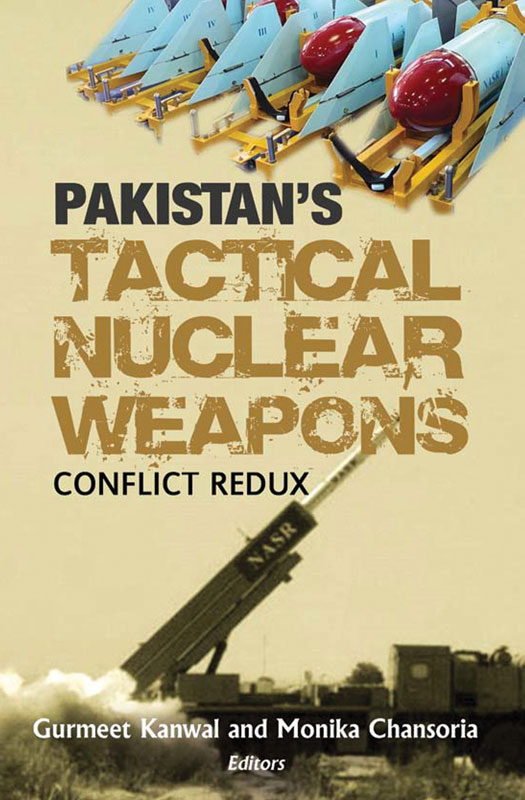
Pakistan's Tactical Nuclear Weapon: Conflict Redux
Tactical nuclear weapons (TNWs), often referred to as “battlefield”, “sub-strategic”, or “non-strategic” nuclear weapons, usually have a plutonium core and are typically distinct from strategic nuclear weapons. Therefore, they warrant a separate consideration in the realm of nuclear security.
- Format
- HardBack
- Pages
- 232 + xvi pp
- Year
- 2014
- ISBN
- 9789381904763
About the Book
Tactical nuclear weapons (TNWs), often referred to as “battlefield”, “sub-strategic”, or “non-strategic” nuclear weapons, usually have a plutonium core and are typically distinct from strategic nuclear weapons. Therefore, they warrant a separate consideration in the realm of nuclear security. The yield of such weapons is generally lower than that of strategic nuclear weapons and may range from the relatively low 0.1 kiloton to a few kilotons.
Pakistan’s quest to acquire tactical nuclear weapons has added a dangerous dimension to the already precarious strategic equation in South Asia. The security discourse in the subcontinent revolves around the perennial apprehension of a conventional or sub- conventional conflict triggering a chain reaction, eventually paving the way for a potential nuclear crisis haunting peace and stability in the region. Pakistan believes that the successful testing of the 60-km nuclear-capable short- range missile Hatf IX (Nasr) “adds deterrence value to Pakistan’s strategic weapons development programme at shorter ranges.”
In paradox, the fact remains that this step has further lowered Pakistan’s nuclear threshold through the likely use of TNWs. The introduction of TNWs into the tactical battle area further exacerbates credibility of their control. Pakistan has not formally declared a nuclear doctrine, but it is well known that nuclear weapons are its first line of defence. The use of TNWs in the India- Pakistan case will alter the strategic scenario completely as Pakistan would threaten India with the use of TNWs in the event of New Delhi responding against Islamabad with a conventional strike in reaction to a 26/11-style terrorist attack. Pakistan forgets that given its offensive strategic posture and continuing involvement in terror strikes in India, it is New Delhi which is confronted with the problem of developing a strategy to counter Pakistan’s “first-strike” and proxy war in light of its declared “no- first-use” policy.
This edited volume attempts to address and decipher complex issues including aspects such as China’s WMD collaboration with Pakistan, nuclear command and control dynamics within Pakistan, overall rationale and implications of TNWs, safety and security of nuclear weapons, scenarios for nuclear usage, India’s potential response options and more specifically, the technical aspects of the Nasr delivery system.